

The shift from after-the-fact reporting to real-time data is a fundamental change in how businesses manage one of their largest and most controllable operating expenses. Whether you are a facilities manager looking to reduce peak demand, an operations director trying to identify equipment inefficiencies, or a CFO seeking better visibility into energy spend across multiple locations, real-time energy analytics provides the data infrastructure to make those decisions with precision rather than guesswork. This article explains how these systems work, what types of analysis are available, and how to apply them to meaningfully reduce your business energy costs.
What Are Real-Time Energy Analytics?
Real-time energy analytics is a system that allows users to continually collect, process, and analyze energy consumption data. These systems often consist of smart meters, IoT technologies, AI energy monitoring software, and older communications protocols that work in conjunction to effectively translate data to a centralized system. Because the modern electrical system has many moving parts and various technologies, implementing effective real-time analytics has become quite a challenge for businesses and grid operators alike. Nonetheless, insights into real-time consumption data are becoming increasingly important as RTO and ISO operators attempt to balance energy supply with demand. Let’s explore some of the details required to properly engineer these systems.
Understanding Real-Time Energy Monitoring
Real-time energy monitoring is the operational backbone of any effective energy management analytics program. For commercial and industrial businesses, the process follows a straightforward data flow that translates raw consumption data into actionable cost reduction decisions.
- Data Collection: Smart meters and IoT sensors installed at the facility level capture electricity and natural gas consumption at regular intervals, typically every 15 to 30 minutes. This interval data provides a granular picture of exactly when and where energy is being consumed throughout the building or campus.
- Centralized Monitoring Platform: Collected data is transmitted to a centralized software platform where it is normalized, standardized, and stored. This is where energy consumption analytics becomes actionable. The platform organizes raw meter data into a structured format that can be queried, compared, and reported on across time periods, locations, and systems.
- Dashboards and Reporting: The monitoring platform surfaces data through dynamic UI dashboards that give facility managers and operations teams real-time visibility into consumption patterns, peak demand events, and cost drivers, without requiring technical expertise to interpret.
- Actionable Decisions: The output of a well-configured monitoring system is a decision. Which equipment is driving peak demand? Which hours are generating the highest costs? Which locations are underperforming relative to similar facilities? Real-time data answers these questions continuously rather than once a month when the utility bill arrives.
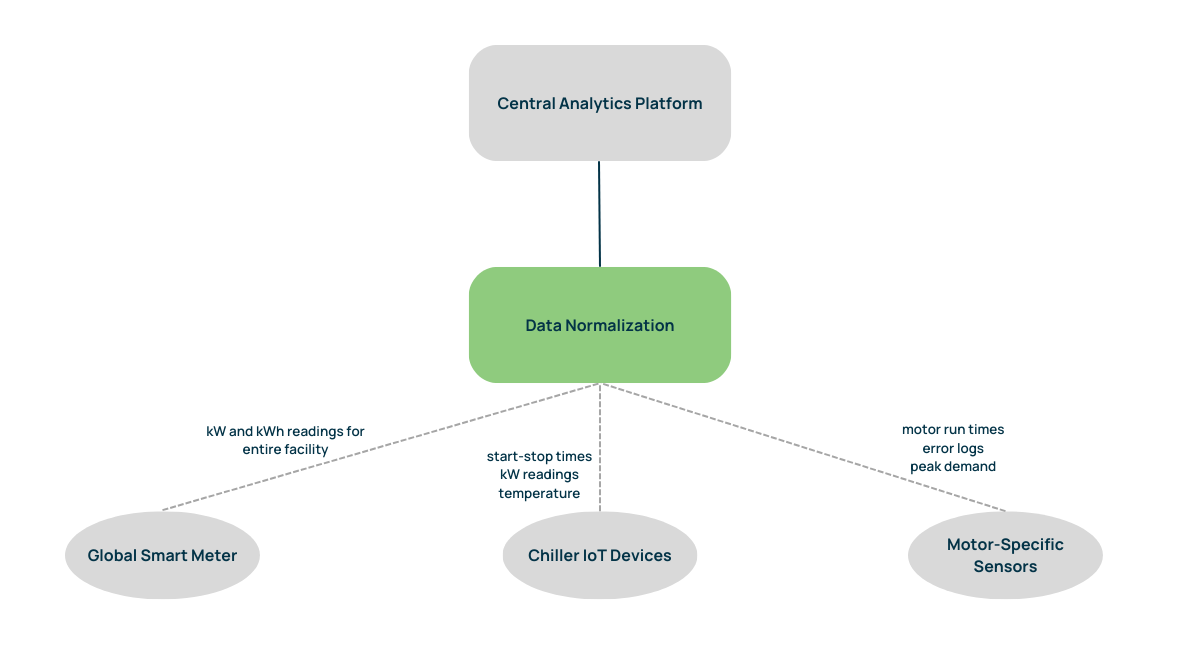
A properly configured energy monitoring system can measure and report on the following datasets:
Energy Consumption
Real-time data tracking allows businesses to identify peak load usage, spot consumption anomalies, and make targeted adjustments to reduce waste. This level of visibility into energy consumption analytics supports both immediate operational changes and longer-term efficiency planning.
Demand Load Forecasting
Accurate demand forecasting helps businesses anticipate peak demand periods that drive capacity costs. This data supports demand response participation and proactive load management strategies (load shifting and peak load shaving) that reduce both utility demand charges and supply-side capacity cost obligations.
Facility and Equipment Performance
Monitoring voltage quality, power factor, and system-level consumption across HVAC, lighting, and production equipment allows facility managers to identify underperforming motors before they generate high energy costs. This replaces reactive maintenance with a data-driven approach to facility performance management.
Asset Monitoring
Tracking the performance of individual motors, HVAC units, and production assets over time allows operators to identify efficiency degradation and address it before it escalates into equipment failure or sustained energy waste.
Types of Business Energy Analysis
Not all energy analysis looks the same. The right approach depends on your facility type, the depth of insight you need, and where you are in your energy management journey. Here are the four most common types of business energy analysis and when each makes sense:
Whole Building Energy Use Analysis
This approach assesses the facility as a single, integrated system rather than evaluating individual equipment or systems in isolation. By analyzing total consumption patterns across the entire building, whole building analysis identifies how operational schedules, occupancy patterns, weather exposure, and building performance interact to drive overall energy costs. It is typically the starting point for any organization looking to develop a comprehensive energy reduction strategy.
Energy Audits
A professional energy audit provides a structured, expert-led assessment of where and how a facility consumes energy. Level I audits involve a physical walkthrough of the facility to identify visible inefficiencies and low-cost improvement opportunities, such as outdated lighting, equipment running during unoccupied hours, or HVAC systems operating outside of optimal parameters. Level II audits go deeper, delivering a detailed engineering analysis of major systems, including HVAC, water heating, compressed air, and production equipment, along with project-level cost and savings estimates for each recommended improvement.
Value Stream Mapping for Manufacturing
For manufacturing and industrial facilities, value stream mapping integrates energy consumption data directly into the production process analysis. Rather than viewing energy as a fixed overhead cost, this approach maps energy use at each stage of the production workflow, identifying where energy is consumed relative to where value is actually being created. The result is a targeted list of process-level changes that reduce energy waste without disrupting production output.
Benchmarking Against Similar Facilities
Benchmarking compares your facility’s energy performance against similar buildings of comparable size, type, and operating profile. Tools like the ENERGY STAR Portfolio Manager provide a standardized framework for this comparison, assigning a performance score that indicates where your facility stands relative to its peers. Benchmarking is particularly useful for multi-site operators who want to identify which locations are underperforming and prioritize energy investment accordingly.
The Benefits Of Real-Time Energy Analytics
There are many advantages of implementing a real-time data monitoring system for both businesses and utilities alike.
For Utilities & Grid Operators
- Improve grid reliability and transition to smart-grid dynamics
- Enhance demand response programs
- Integrate renewable energy generation seamlessly into the power system
- Dispatch battery resources to combat real-time spikes in consumer demand
- Lower costs through fault-detection and predictive maintenance
- Lessen the need for real-time energy market dispatch through accurate forecasting in the day-ahead markets
- Accurately price FTR contracts by forecasting nodal and zonal pricing
For Commercial & Industrial Customers
- Lower energy costs through accurate efficiency planning
- Ensure accuracy in billing without having to conduct retro-active utility bill audits
- Optimize energy usage during lower-cost, off-peak periods
- Support sustainability goals through accurate renewable energy production data
- Enhance decarbonization efforts through accurate reporting
- Reduce maintenance costs through preventative actions
Benefits of Energy Usage Analytics
Implementing an energy analytics program delivers measurable returns across three dimensions that matter directly to commercial and industrial operators: cost, operations, and compliance.
Lower Operating Costs
The most immediate and quantifiable benefit of energy usage analytics is cost reduction. Businesses that systematically analyze and act on consumption data consistently identify inefficiencies that, when addressed, produce energy cost savings of 10 – 30% relative to unmanaged spending. These savings come from a combination of sources, reduced peak demand charges, elimination of energy waste during unoccupied hours, more efficient equipment operation, and better-informed procurement decisions driven by accurate interval consumption data. For a business spending $500,000 annually on electricity and natural gas, a 15% reduction represents $75,000 in recovered operating cost every year.
Extended Equipment and Asset Lifespan
Energy analytics also reduces what you spend on equipment maintenance and replacement. Continuous monitoring of HVAC systems, motors, compressors, and production equipment identifies performance degradation before it escalates into failure. A motor running inefficiently draws more power than its rated capacity, drives up demand charges, and is heading toward a breakdown that a real-time monitoring alert could have prevented weeks earlier. Optimizing energy use across major systems reduces mechanical strain, extends useful asset life, and lowers the total cost of facility operations.
Sustainability Compliance and Carbon Footprint Improvement
Accurate, interval-level consumption data is the foundation of any credible sustainability reporting program. Businesses facing ESG reporting requirements, state-level energy efficiency mandates, or voluntary carbon reduction commitments need granular consumption data to measure progress, demonstrate compliance, and identify where further reductions are achievable. Energy analytics provides the data infrastructure enabling accurate carbon footprint calculations, renewable energy tracking, and the documentation required to support sustainability certifications and disclosure obligations.
Challenges Of Implementing Real-Time Data Analytics
Despite the many benefits of having a tool to report on energy consumption in real time, implementing these systems properly can be quite challenging. Here’s why:
Data Complexity
Collecting and processing large amounts of data can be challenging for any organization. The need for competent data scientists and software engineers is almost a must to take on this task. Today, artificial intelligence is playing a larger role in data collection; however, it requires a human-in-the-loop approach so that the system can be engineered properly to your needs.
Integrating With Legacy Systems
While the energy sector has experienced many technological advancements, most systems are still operating on dated legacy systems. Finding ways to collect and integrate data from analog systems can be challenging, to say the least, if not impossible.
Cybersecurity Risks
Today, the electricity grid still operates on analog protocol as a security measure. In fact, electric generators are required to communicate with RTOs and ISOs via Skada and RTU protocols. Introducing newer technologies into the system poses a security risk challenge that many grid operators have yet to solve.
Implementation Costs
Lastly, purchasing energy data analytics tools, or designing your own system, can be quite costly. It’s important to do a cost-benefit analysis to evaluate if a return on investment is possible. The payback periods could be too long for smaller energy users.
Steps to Perform a Business Energy Usage Analysis
A structured energy usage analysis does not require a sophisticated technology platform to get started. The following four-step framework gives commercial and industrial operators a repeatable process for identifying inefficiencies, prioritizing improvements, and measuring results over time.
Step 1: Collect 12 or More Months of Utility Data
Begin by gathering at least 12 months of electricity and natural gas billing data across all meters and service accounts associated with the facility. A full year of data captures seasonal consumption patterns, peak demand events, and billing anomalies that a shorter data window would miss. Where interval data is available through smart meters or a utility portal, download it at the 15 or 30-minute level. This granularity reveals intraday consumption patterns and demand spikes that monthly billing misses entirely.
Step 2: Conduct a Facility Walkthrough
A physical walkthrough of the facility identifies visible inefficiencies that data alone may not surface. Look for equipment operating during unoccupied hours, outdated lighting in storage or common areas, HVAC systems running on schedules that do not match actual occupancy, and any process or system that appears to be running continuously without a clear operational reason. These observations often reveal the fastest and lowest-cost improvement opportunities available without a need for capital investment.
Step 3: Evaluate Major Systems
With billing data and walkthrough observations in hand, conduct a detailed assessment of the facility’s highest-draw systems. HVAC typically represents the largest single energy load in most commercial buildings and requires close evaluation of scheduling, setpoints, maintenance, and equipment age. Water heating, compressed air systems, refrigeration, and production equipment should each be assessed for efficiency relative to current operating requirements. This is also the appropriate stage to engage a professional energy auditor for a Level II assessment if the facility’s complexity or energy spend justifies the investment.
Step 4: Prioritize and Implement Changes Based on Cost and Savings Impact
Not all efficiency improvements are created equal. Rank identified opportunities by estimated annual savings and implementation cost. Quick measures with minimal capital requirements and rapid payback, such as LED lighting retrofits, HVAC scheduling adjustments, and equipment shutdown protocols, should be implemented first to generate immediate savings that can fund more capital-intensive projects. Larger investments such as HVAC replacement, building automation systems, or on-site generation should be evaluated on a full ROI basis with realistic payback period projections.
Want Help Analyzing Energy Data For Better Outcomes?
Having an effective data reporting tool can not only make your business more efficient, it can also drastically improve your bottom line. But, implementing these systems can be confusing and challenging. At Diversegy, our team of energy experts has over 100 years of combined experience analyzing energy consumption data to help our clients make better decisions. Whether you are a large organization ready to invest in energy technology or simply looking for better data to make informed decisions, we can help. Contact our team today to learn more about how you can utilize our years of energy experience.